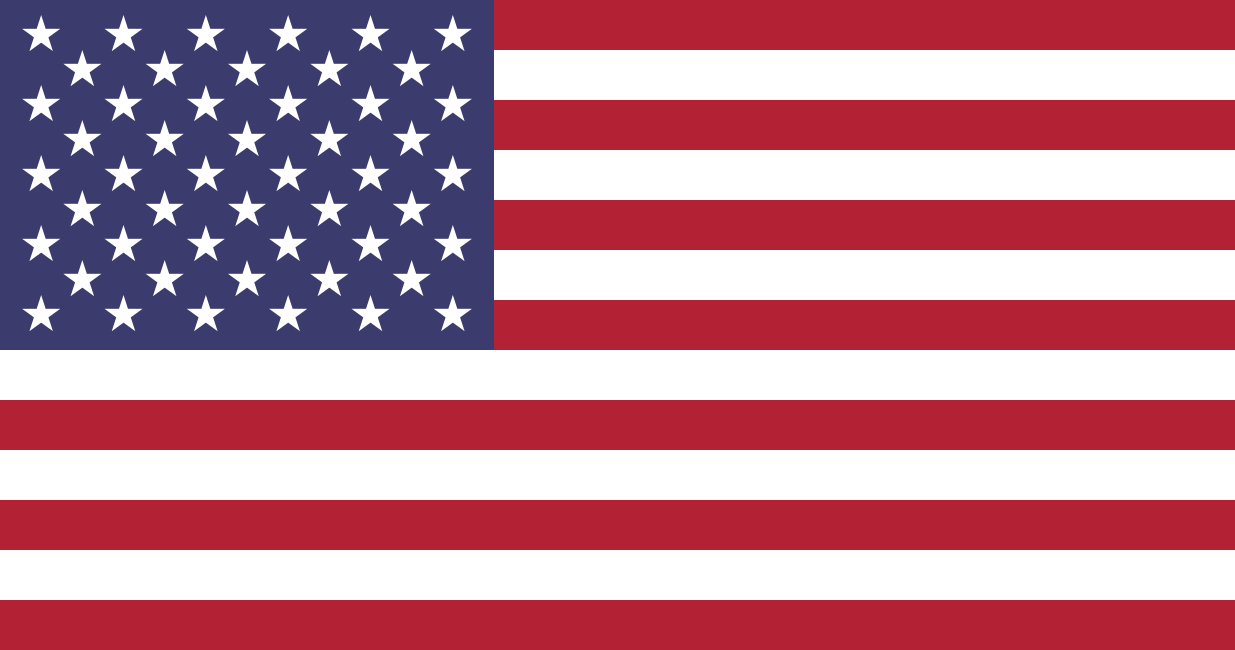
United States Minor Outlying Islands
Capital
Washington DC
Region
Americas
Population
N/A
Area (km²)
34.2
The United States Minor Outlying Islands are a collection of remote, mostly uninhabited atolls and islands scattered across the Pacific Ocean, administered as U.S. territories with Washington, D.C., serving as their de facto capital. Spanning just 34.2 km² in total area and classified in the Americas region, they lack a permanent population and have no recorded GDP, primarily functioning as wildlife refuges, military sites, or scientific outposts. Despite their isolation, these specks of land highlight America's far-flung territorial reach and ecological significance.
Key Insights
Due to the lack of permanent residents and civilian infrastructure, standard metrics like GDP per capita, literacy rates, or life expectancy are non-applicable or not collected. This makes traditional socio-economic comparison impossible, highlighting their unique status as administrative rather than functional states.
Despite being grouped under a single statistical entity, the islands are geographically disparate, spanning both the Pacific Ocean (e.g., Midway Atoll, Wake Island) and the Caribbean Sea (e.g., Navassa Island). This vast separation complicates any unified regional analysis or environmental management strategy.
Since there is no permanent population and no significant civilian economic activity (GDP is effectively zero or non-existent), the 'economy' is entirely driven by external factors. Any economic input is limited to temporary military, scientific, or conservation budgets funded by the US government.
The total land area is minuscule at only 34.20 square kilometers, comparable to a small city park. However, their strategic location grants the US control over vast exclusive economic zones (EEZs) in the Pacific and Caribbean, making them geopolitically significant far beyond their physical size.
No economic data available
Share This Country
Travel & Tourism
External References & Resources
Wikipedia
Comprehensive encyclopedia article
Grokipedia
AI-powered encyclopedia search
Google Search
Latest news and information
Google News
Latest news coverage for United States Minor Outlying Islands
CIA World Factbook
Official intelligence data
BBC News
Trusted news and analysis
UN Data
Official United Nations statistics
World Bank Data
Economic and development indicators