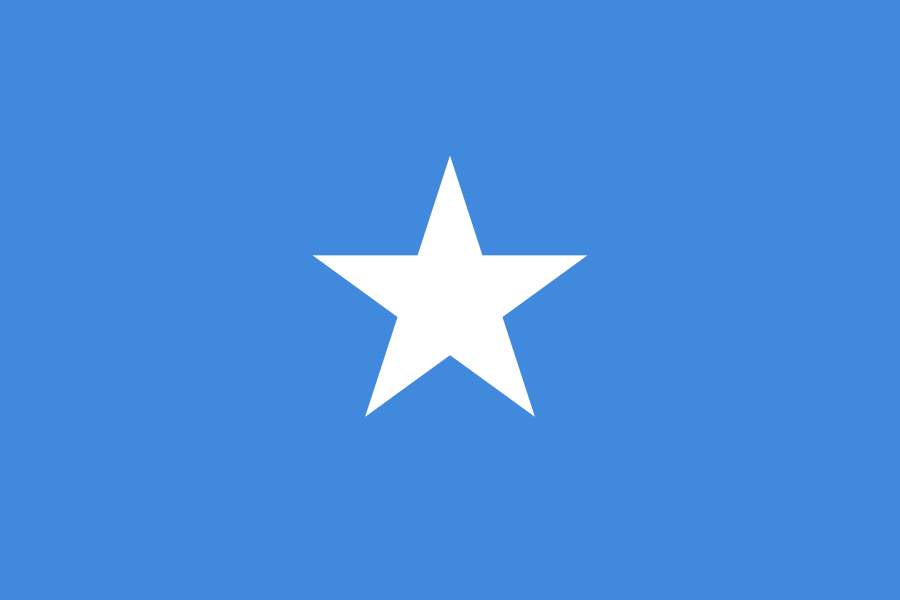
Somalia
Federal Republic of Somalia
Capital
Mogadishu
Region
Africa
Population
19,655,000
Area (km²)
637,657
Somalia, located in the Horn of Africa, spans 637,657 km² and is home to about 19.7 million people, with Mogadishu serving as its bustling capital. Despite its rich cultural heritage and strategic coastline along the Indian Ocean, the country faces ongoing challenges with economic data often unavailable (GDP: N/A), reflecting its turbulent history of conflict and recovery efforts. Engagingly, Somalia boasts ancient trade routes and resilient nomadic traditions that continue to shape its vibrant society.
Key Insights
Despite achieving a relatively strong GDP growth rate of 4.175%, the country struggles with a very high unemployment rate of 18.941%. This suggests that the economic growth is not sufficiently inclusive or job-creating, failing to absorb the large, young workforce entering the labor market.
A majority of the population (54.071%) now resides in urban areas, which is a surprisingly high rate for a country with such low GDP per capita and high instability. This suggests significant internal migration, likely driven by conflict, drought, and the search for economic opportunities concentrated in major cities like Mogadishu.
The infant mortality rate stands at a critical 67.800 per 1,000 live births, coupled with a low life expectancy of just 58.82 years. These figures highlight severe deficiencies in healthcare access, sanitation, and nutrition, indicating a major public health emergency compared to global standards.
The exceptionally high fertility rate of 6.13 children per woman is a dominant demographic factor, ensuring rapid population expansion. This rate, combined with a relatively young population (implied by the high fertility), puts immense pressure on limited resources, infrastructure, and job creation in the future.
GDP (Current US$)
$10.96B
Year: 2023
GDP Per Capita
$596.89
GDP Growth (%)
4.18%
Inflation (%)
N/A%
Unemployment (%)
18.94%
Debt to GDP (%)
N/A%
Source: World Bank • Last updated: 12/24/2025
Historical Trends & Data Visualizations
- GDP Growth (%)
- Population
- Life Expectancy (years)
- Renewable Energy (%)
- GDP Per Capita ($)
Share This Country
External References & Resources
Wikipedia
Comprehensive encyclopedia article
Grokipedia
AI-powered encyclopedia search
Google Search
Latest news and information
Google News
Latest news coverage for Somalia
CIA World Factbook
Official intelligence data
BBC News
Trusted news and analysis
UN Data
Official United Nations statistics
World Bank Data
Economic and development indicators