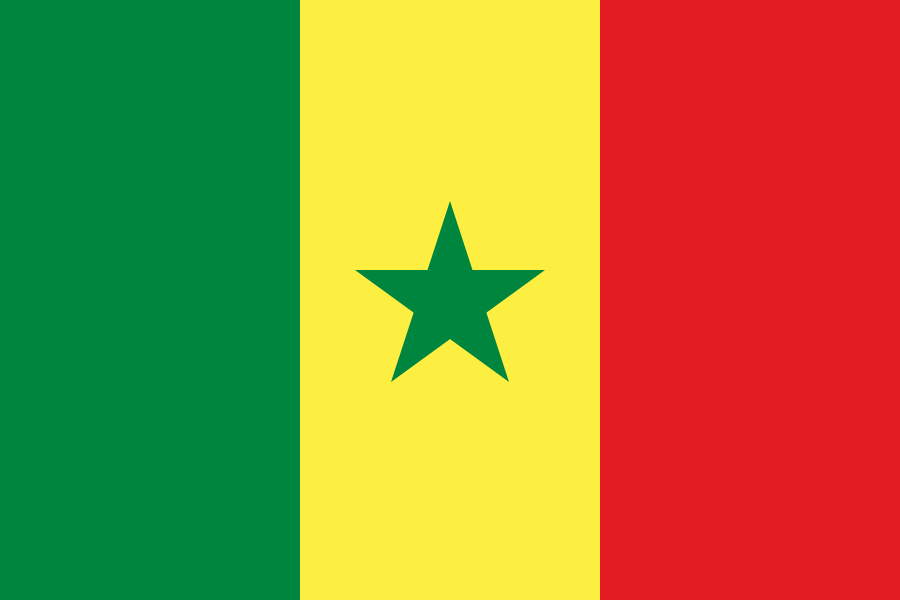
Senegal
Republic of Senegal
Capital
Dakar
Region
Africa
Population
18,593,258
Area (km²)
196,722
Senegal, a West African nation with a population of around 18.6 million, spans 196,722 km² and features the bustling coastal capital of Dakar as its cultural and economic hub. Renowned for its political stability and vibrant traditions like Senegalese wrestling and mbalax music, the country thrives on agriculture, fishing, and emerging tourism, though GDP data is currently unavailable. With a mix of Sahelian landscapes and Atlantic beaches, Senegal stands out as one of Africa's most progressive democracies, emphasizing education and regional peacekeeping.
Key Insights
Senegal has managed to keep its Infant Mortality Rate (30.200 per 1,000 live births) lower than many comparable low-income countries in Sub-Saharan Africa. While still high by global standards, this figure suggests successful implementation of basic maternal and child health interventions, despite the low GDP per capita and high fertility rate.
Senegal is highly urbanized for a West African nation, with over half the population residing in urban areas. This concentration likely facilitates infrastructure development, evidenced by a relatively high Access to Electricity rate of 74.200%. Sustaining this progress requires managing urban sprawl and ensuring equitable service distribution to the growing population.
Senegal reports a remarkably low official unemployment rate (2.800%), which is comparable to highly developed economies. However, this statistic contrasts sharply with the very low GDP per capita ($1,698.03). This suggests that while formal unemployment is low, the majority of the working population is likely engaged in low-productivity, informal, or underemployed labor, rather than high-wage jobs.
Despite achieving significant urbanization (over 54% of the population lives in cities) and showing moderate economic growth, Senegal's Literacy Rate stands at a low 50.360%. This low level of foundational education poses a severe constraint on future economic diversification, technological adoption, and the ability of the workforce to transition into higher-value sectors.
GDP (Current US$)
$30.70B
Year: 2023
GDP Per Capita
$1,698.03
GDP Growth (%)
4.26%
Inflation (%)
5.94%
Unemployment (%)
2.8%
Debt to GDP (%)
N/A%
Source: World Bank • Last updated: 12/24/2025
Historical Trends & Data Visualizations
- GDP Growth (%)
- Population
- Life Expectancy (years)
- Renewable Energy (%)
- GDP Per Capita ($)
Share This Country
News
Real Estate
Events
Government
Travel & Tourism
External References & Resources
Wikipedia
Comprehensive encyclopedia article
Grokipedia
AI-powered encyclopedia search
Google Search
Latest news and information
Google News
Latest news coverage for Senegal
CIA World Factbook
Official intelligence data
BBC News
Trusted news and analysis
UN Data
Official United Nations statistics
World Bank Data
Economic and development indicators