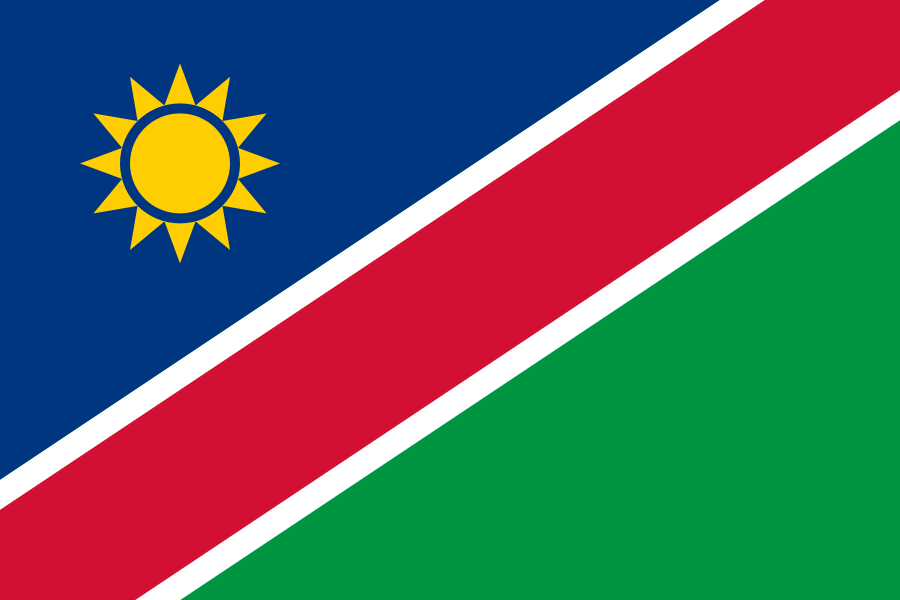
Namibia
Republic of Namibia
Capital
Windhoek
Region
Africa
Population
3,022,401
Area (km²)
825,615
Namibia, a vast southern African nation spanning 825,615 km², boasts a population of about 3 million people and is renowned for its stunning landscapes, including the ancient Namib Desert and Etosha National Park teeming with wildlife. Its capital, Windhoek, serves as the economic and cultural hub, blending German colonial influences with modern African vibrancy, while the country's economy thrives on mining, tourism, and agriculture despite challenges like arid conditions. With a history of gaining independence in 1990, Namibia emphasizes conservation and has one of the world's highest rates of press freedom in Africa.
Key Insights
Namibia exhibits a significant economic paradox: strong GDP growth (4.443%) suggests a recovering economy, yet the unemployment rate remains extremely high at nearly 20%. This indicates that the economic growth is likely concentrated in capital-intensive sectors (like mining) that do not generate sufficient jobs to absorb the labor force, highlighting structural inequality.
With a GDP per capita of $4,187.61, Namibia is classified as an upper-middle-income country. However, this wealth does not translate into universal access to basic services, as evidenced by the low national access to electricity (56.7%) and a relatively high infant mortality rate (38.4 per 1,000 live births), suggesting severe internal disparities.
Namibia boasts a high literacy rate (87.64%), which is commendable for the region and suggests high educational attainment. However, this educational success contrasts sharply with a relatively low life expectancy (67.39 years) and high infant mortality, indicating that systemic health crises (like HIV/AIDS or inadequate infrastructure) significantly undermine human development gains.
Namibia's urban population is currently at 49.955%, meaning the country is on the verge of becoming predominantly urbanized. This rapid shift places immense pressure on municipal services, infrastructure, and job creation in cities like Windhoek, potentially exacerbating the already high unemployment and electricity access issues.
GDP (Current US$)
$12.41B
Year: 2023
GDP Per Capita
$4,187.61
GDP Growth (%)
4.44%
Inflation (%)
5.88%
Unemployment (%)
19.37%
Debt to GDP (%)
N/A%
Source: World Bank • Last updated: 12/24/2025
Historical Trends & Data Visualizations
- GDP Growth (%)
- Population
- Life Expectancy (years)
- Renewable Energy (%)
- GDP Per Capita ($)
Share This Country
News
Real Estate
Events
Government
Travel & Tourism
External References & Resources
Wikipedia
Comprehensive encyclopedia article
Grokipedia
AI-powered encyclopedia search
Google Search
Latest news and information
Google News
Latest news coverage for Namibia
CIA World Factbook
Official intelligence data
BBC News
Trusted news and analysis
UN Data
Official United Nations statistics
World Bank Data
Economic and development indicators