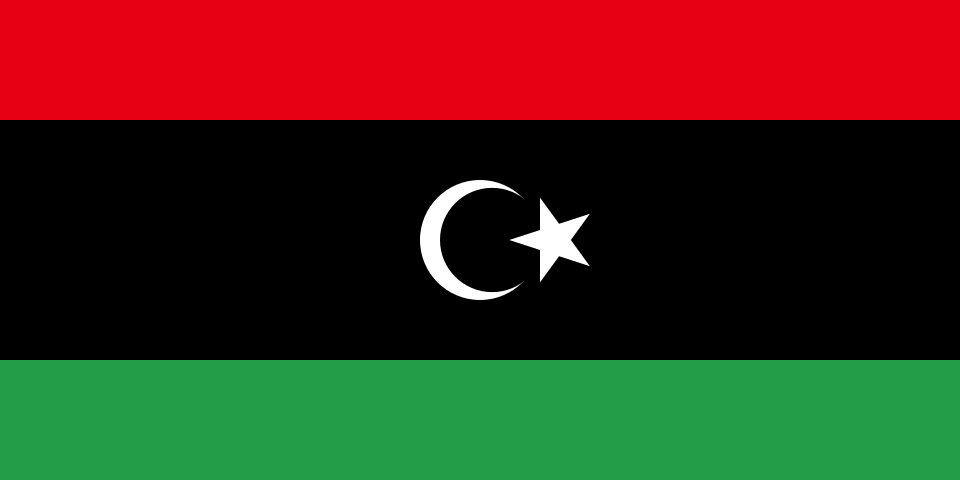
Libya
State of Libya
Capital
Tripoli
Region
Africa
Population
7,459,000
Area (km²)
1,759,540
Libya, a North African nation with a population of about 7.5 million, spans a vast 1.76 million square kilometers of mostly desert terrain, making it one of the continent's largest countries by area. Its capital, Tripoli, serves as the political and economic hub, though GDP data is currently unavailable amid ongoing instability. Rich in oil reserves, Libya has faced political turmoil since the 2011 revolution, but its strategic Mediterranean location continues to draw global interest.
Key Insights
Libya's life expectancy (69.34 years) and infant mortality rate (15.900 per 1,000 births) place it in a moderate bracket, reflecting challenges in maintaining consistent public health services. While better than many low-income countries, these figures indicate that the high oil revenues have not fully translated into optimal health outcomes comparable to high-income nations.
Despite years of conflict and political instability, Libya maintains a relatively high GDP per capita of $6,026.52. This figure, driven primarily by oil wealth and a small population, contrasts sharply with many Sub-Saharan African nations and underscores the potential economic strength if stability were achieved.
Libya's environmental profile shows minimal forest area (0.123%), typical for a desert climate. More critically, despite being a major oil producer, access to electricity stands at only 73.200%. This significant gap suggests major infrastructural deficits in power distribution, failing to reach over a quarter of the population.
A striking majority of Libya's population (87.865%) lives in urban areas, which is very high even for a developing nation. This concentration highlights the challenges of inhabiting the vast desert interior and suggests that infrastructure and services are heavily centralized along the coast, despite the country's huge land area of 1.76 million square kilometers.
GDP (Current US$)
$44.03B
Year: 2023
GDP Per Capita
$6,026.52
GDP Growth (%)
10.2%
Inflation (%)
2.37%
Unemployment (%)
18.75%
Debt to GDP (%)
N/A%
Source: World Bank • Last updated: 12/24/2025
Historical Trends & Data Visualizations
- GDP Growth (%)
- Population
- Life Expectancy (years)
- Renewable Energy (%)
- GDP Per Capita ($)
Share This Country
External References & Resources
Wikipedia
Comprehensive encyclopedia article
Grokipedia
AI-powered encyclopedia search
Google Search
Latest news and information
Google News
Latest news coverage for Libya
CIA World Factbook
Official intelligence data
BBC News
Trusted news and analysis
UN Data
Official United Nations statistics
World Bank Data
Economic and development indicators