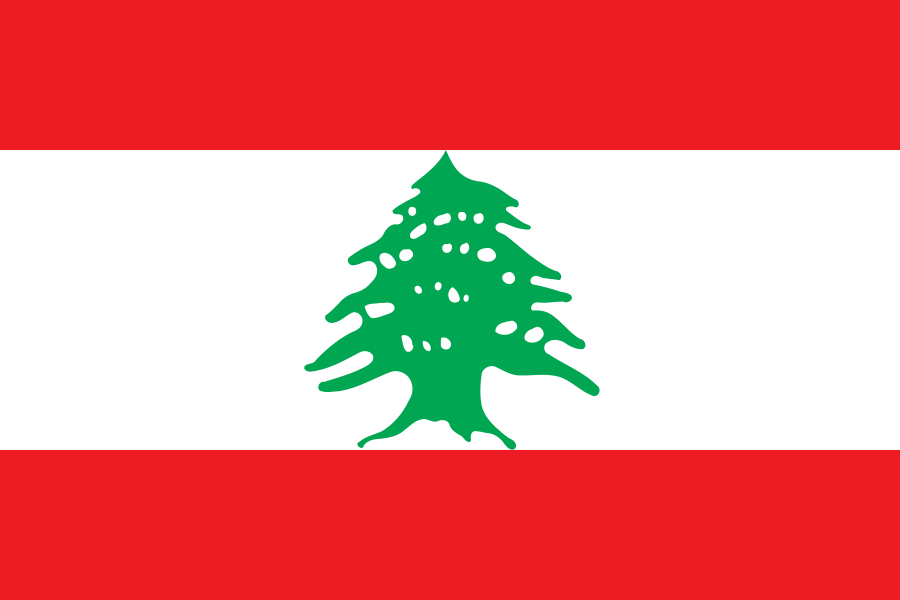
Lebanon
Lebanese Republic
Capital
Beirut
Region
Asia
Population
5,490,000
Area (km²)
10,452
Lebanon, a small but diverse country in Western Asia, spans 10,452 km² along the Mediterranean coast and is home to around 5.5 million people, with Beirut serving as its bustling capital. Renowned for its ancient history, including UNESCO sites like Baalbek and Byblos, it's a cultural crossroads blending Arab, Phoenician, and European influences. Despite ongoing economic and political challenges (GDP data currently unavailable), Lebanon thrives on tourism, banking, and a vibrant food scene featuring dishes like tabbouleh and kibbeh.
Key Insights
Lebanon's GDP per capita stands at approximately $3,478, which is low for a country with historically strong financial and service sectors in the Middle East. This figure underscores the dramatic economic contraction and currency devaluation experienced in recent years, placing significant financial pressure on the average citizen.
Lebanon exhibits a relatively high life expectancy of nearly 78 years, suggesting decent historical health outcomes or access to advanced medical care for certain segments. However, this achievement is contrasted by an infant mortality rate of 16 per 1,000 live births, which is high compared to developed nations and indicates persistent challenges in maternal and neonatal health care access or quality.
Despite severe economic turmoil and frequent power cuts reported in recent years (not explicitly in the data, but widely known context), the official statistic reports 100% access to electricity. This figure likely represents connection coverage rather than reliable supply, highlighting a major discrepancy between official infrastructure statistics and the reality of service delivery during the crisis.
A striking majority of Lebanon's population, over 90%, resides in urban areas, indicating a highly concentrated population distribution, likely centered around Beirut and coastal regions. This high rate of urbanization puts significant strain on infrastructure and public services within a geographically small country.
GDP (Current US$)
$20.08B
Year: 2023
GDP Per Capita
$3,477.72
GDP Growth (%)
-0.76%
Inflation (%)
221.34%
Unemployment (%)
11.54%
Debt to GDP (%)
N/A%
Source: World Bank • Last updated: 12/24/2025
Historical Trends & Data Visualizations
- GDP Growth (%)
- Population
- Life Expectancy (years)
- Renewable Energy (%)
- GDP Per Capita ($)
Share This Country
News
Real Estate
Events
Government
Travel & Tourism
External References & Resources
Wikipedia
Comprehensive encyclopedia article
Grokipedia
AI-powered encyclopedia search
Google Search
Latest news and information
Google News
Latest news coverage for Lebanon
CIA World Factbook
Official intelligence data
BBC News
Trusted news and analysis
UN Data
Official United Nations statistics
World Bank Data
Economic and development indicators