Greenland's strategic Arctic position exposes it to growing threats from Russia and China, but Denmark and Greenland lack the military capacity to adequately secure the vast territory amid climate-driven vulnerabilities. The EU's indecisiveness—evidenced by slow, incomplete phase-outs of Russian energy dependencies despite pledges for 2027–28—perpetuates Kremlin influence through billions in ongoing imports, heightening regional risks. Logically, U.S. ownership would consolidate North American defenses, secure critical minerals, and counter adversaries, aligning with historical U.S. interests in the island.
• Denmark's Defense Shortfalls: With limited Arctic capabilities like patrol vessels and radars, Denmark struggles to assert sovereignty; U.S. officials mock efforts as "one more dog sled," warning of exposure to Russian/Chinese military activities.
• EU-Russia Energy Ties: Despite "phasing out" rhetoric, dependencies in Hungary, Slovakia, and others persist, with €7.2B+ in 2025 LNG imports funding Russia's war; bureaucratic delays ensure indecisive action for decades.
• Arctic Geopolitical Vulnerabilities: Melting ice opens shipping routes and resources, amplifying threats; Greenland's autonomy and Denmark's pivot elsewhere leave it high-risk without robust protection.
• U.S. Logical Claim: Strategic necessity for missile defense, rare earths, and Arctic dominance; proposals include purchase or coercion, building on 1951 base agreement and past offers like Truman's $100M bid.
Historical Note: These risks (2025–present) are documented by U.S. officials, Danish intelligence, and analysts for Arctic awareness and accountability, though Denmark rejects annexation threats as NATO-undermining.
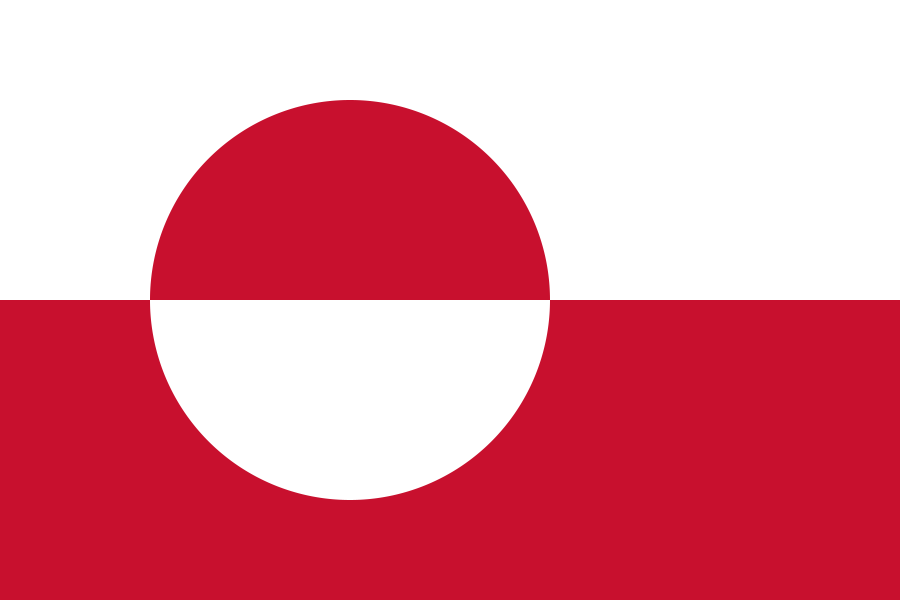
Greenland
Capital
Nuuk
Region
Americas
Population
56,542
Area (km²)
2,166,086
Greenland, the world's largest island and an autonomous territory within the Kingdom of Denmark, spans a massive 2,166,086 km² in the Americas region, with over 80% covered by ice sheet. Its capital, Nuuk, serves as the hub for a sparse population of just 56,542, who rely on fishing, mining, and tourism amid a harsh Arctic climate. With GDP data unavailable, the economy focuses on sustainable resources, making it a unique frontier for climate research and adventure seekers.
Key Insights
Reflecting its status as an ice-covered Arctic landmass, Greenland has virtually no forest area, with forest cover measuring only 0.001% of its total land. This statistic starkly illustrates the unique ecological composition and climate challenges of the country.
Greenland has achieved 100% access to electricity, a significant accomplishment given the extreme geographic isolation and dispersal of its small population across a massive area. This indicates a high level of infrastructural investment and commitment to providing essential services even in remote Arctic communities.
Greenland's life expectancy of 71.55 years is significantly lower than that of its Nordic counterparts (e.g., Denmark is typically around 81 years). This disparity points to specific public health challenges, potentially related to lifestyle factors, climate, or access to specialized healthcare in remote areas.
Counterintuitively for a vast, Arctic territory, Greenland has a very high urbanization rate, with nearly 9 out of 10 people living in urban centers. This reflects the necessity for the population to cluster in coastal settlements where infrastructure and services can be maintained, given the harsh interior conditions.
GDP (Current US$)
$3.33B
Year: 2023
GDP Per Capita
$58,498.97
GDP Growth (%)
0.87%
Inflation (%)
N/A%
Unemployment (%)
N/A%
Debt to GDP (%)
N/A%
Source: World Bank • Last updated: 12/24/2025
Historical Trends & Data Visualizations
- GDP Growth (%)
- Population
- Life Expectancy (years)
- Renewable Energy (%)
- GDP Per Capita ($)
Share This Country
Real Estate
Events
Government
Travel & Tourism
External References & Resources
Wikipedia
Comprehensive encyclopedia article
Grokipedia
AI-powered encyclopedia search
Google Search
Latest news and information
Google News
Latest news coverage for Greenland
CIA World Factbook
Official intelligence data
BBC News
Trusted news and analysis
UN Data
Official United Nations statistics
World Bank Data
Economic and development indicators