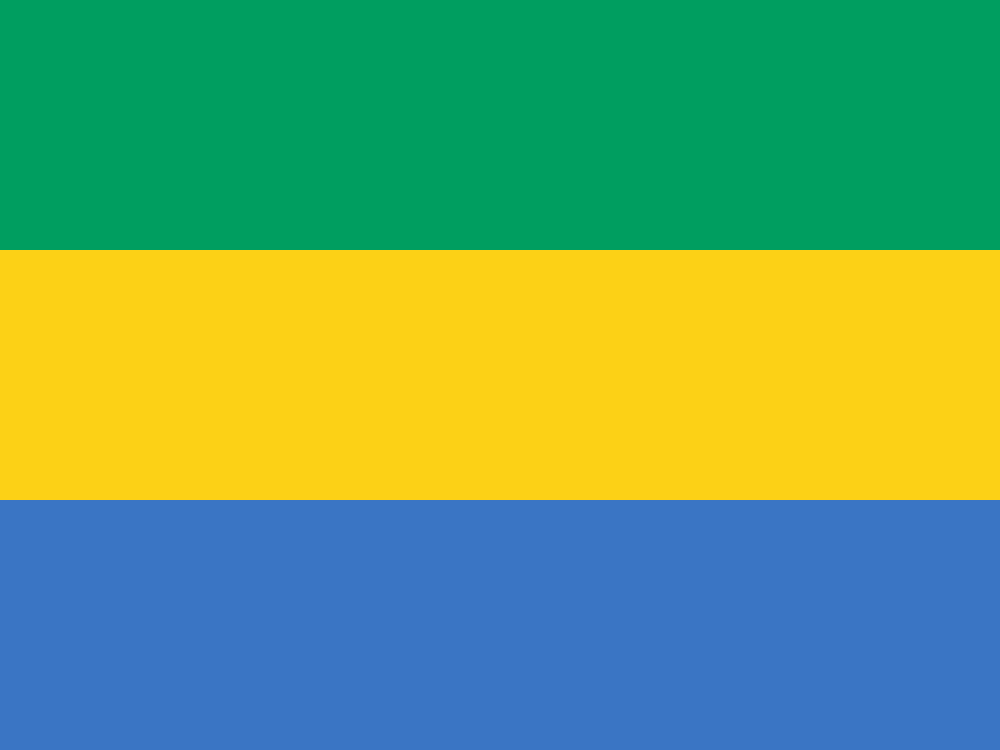
Gabon
Gabonese Republic
Capital
Libreville
Region
Africa
Population
2,469,296
Area (km²)
267,668
Gabon, a Central African nation with a population of about 2.5 million, spans 267,668 km² of lush rainforests and coastline, making it one of the continent's most biodiverse spots. Its capital, Libreville, serves as the economic hub, though GDP data is currently unavailable amid its oil-dependent economy. Despite its natural wealth, Gabon faces challenges like income inequality and conservation efforts to protect its unique wildlife.
Key Insights
Despite being a developing nation in Middle Africa, Gabon has achieved widespread electrical connectivity, with 94.10% of the population having access to electricity. This high rate is crucial for economic development and quality of life, placing it significantly ahead of many regional neighbors.
Gabon's Infant Mortality Rate (IMR) of 26.5 per 1,000 live births is relatively low compared to the average for Sub-Saharan Africa (which often exceeds 40). Combined with a life expectancy of 68.34 years, this suggests better than average public health infrastructure, likely supported by its oil wealth.
Gabon maintains an astonishing 91.182% forest cover, making it a critical global carbon sink and a leader in conservation efforts. This high percentage is a defining characteristic of the country, emphasizing its environmental importance and the challenge of balancing resource extraction with ecological preservation.
Gabon is one of the most urbanized countries in Africa, with over 91% of its population living in urban areas. This extreme concentration suggests significant internal migration toward economic centers and places immense pressure on urban infrastructure and services, contrasting sharply with its vast, sparsely populated forest areas.
GDP (Current US$)
$19.39B
Year: 2023
GDP Per Capita
$7,802.82
GDP Growth (%)
2.44%
Inflation (%)
3.63%
Unemployment (%)
20.28%
Debt to GDP (%)
N/A%
Source: World Bank • Last updated: 12/24/2025
Historical Trends & Data Visualizations
- GDP Growth (%)
- Population
- Life Expectancy (years)
- Renewable Energy (%)
- GDP Per Capita ($)
Share This Country
Real Estate
Government
Travel & Tourism
External References & Resources
Wikipedia
Comprehensive encyclopedia article
Grokipedia
AI-powered encyclopedia search
Google Search
Latest news and information
Google News
Latest news coverage for Gabon
CIA World Factbook
Official intelligence data
BBC News
Trusted news and analysis
UN Data
Official United Nations statistics
World Bank Data
Economic and development indicators