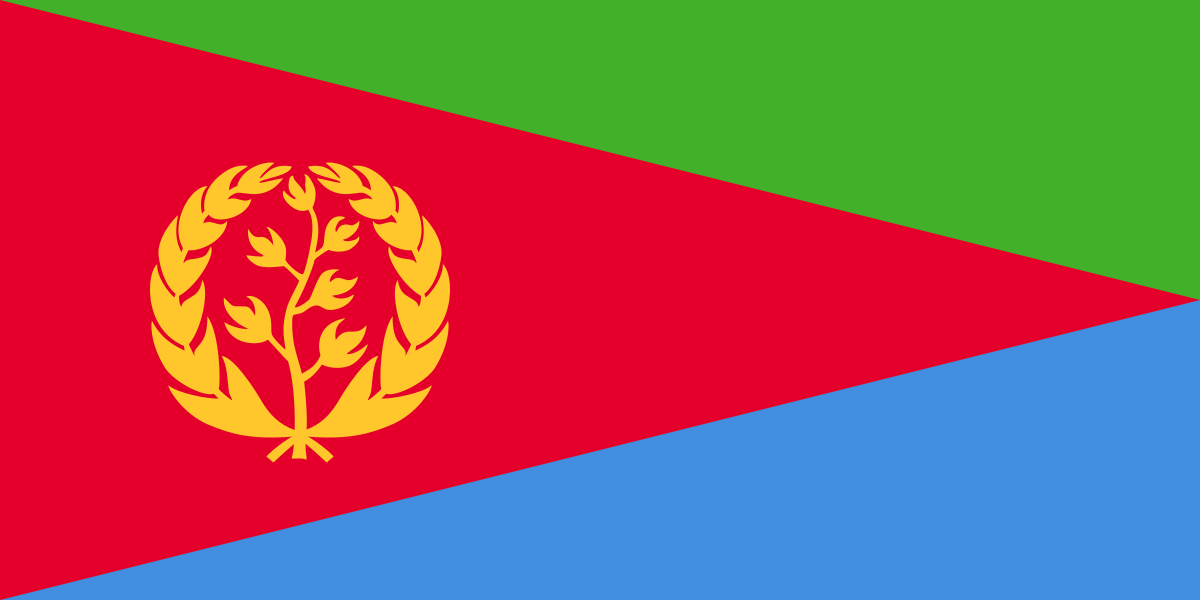
Eritrea
State of Eritrea
Capital
Asmara
Region
Africa
Population
3,607,000
Area (km²)
117,600
Eritrea, a coastal nation in the Horn of Africa, spans 117,600 km² and is home to around 3.6 million people, with Asmara serving as its historic capital known for Italian colonial architecture. Gaining independence from Ethiopia in 1993 after a long struggle, it boasts diverse landscapes from Red Sea beaches to arid highlands. While GDP figures are unavailable, the country relies on agriculture, mining, and remittances amid ongoing economic challenges.
Key Insights
Eritrea maintains 8.63% forest area, which is notable given its location in the arid Horn of Africa. This suggests successful conservation efforts or specific geographical features (like highlands) that support forestation, contrasting with the severe deforestation issues faced by some neighboring countries.
Access to electricity is reported at 54.4%. While exceeding 50%, this figure is relatively low for a nation with a small population base, suggesting significant infrastructural deficits and hindering industrial development, particularly in rural areas where the majority of the population resides.
Only about one-third of Eritrea's population (34.696%) lives in urban areas. For a relatively small country (population 3.47 million), this low urbanization rate indicates that the majority of the population remains reliant on rural, likely agricultural, livelihoods, contrasting with global trends of rapid urbanization.
The infant mortality rate stands at 25.5 per 1,000 live births. While still high by global standards, this represents significant progress compared to many Sub-Saharan African nations, suggesting effective localized public health interventions or vaccination programs, despite limited reported health expenditure data.
GDP (Current US$)
$N/A
Year: 2023
GDP Per Capita
$N/A
GDP Growth (%)
N/A%
Inflation (%)
N/A%
Unemployment (%)
5.59%
Debt to GDP (%)
N/A%
Source: World Bank • Last updated: 12/24/2025
Historical Trends & Data Visualizations
No data available
- Population
- Life Expectancy (years)
- Renewable Energy (%)
No data available
Share This Country
External References & Resources
Wikipedia
Comprehensive encyclopedia article
Grokipedia
AI-powered encyclopedia search
Google Search
Latest news and information
Google News
Latest news coverage for Eritrea
CIA World Factbook
Official intelligence data
BBC News
Trusted news and analysis
UN Data
Official United Nations statistics
World Bank Data
Economic and development indicators