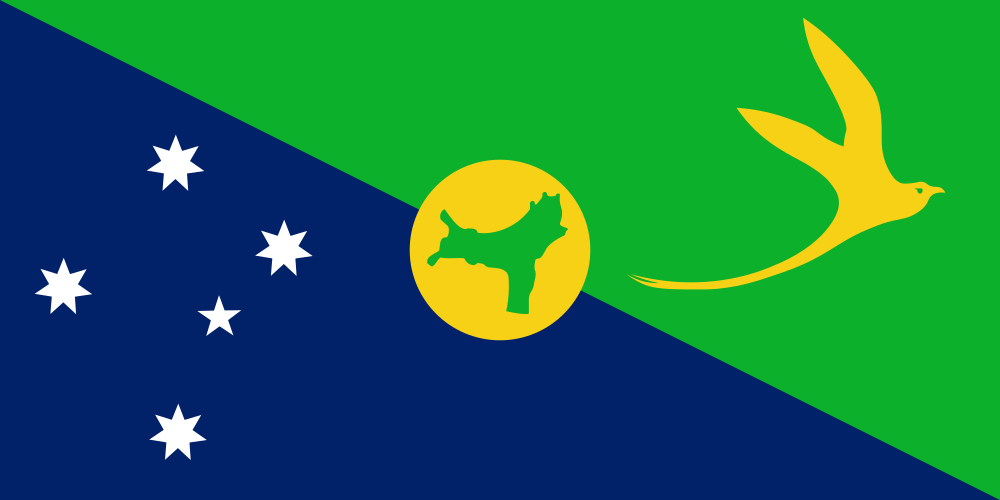
Christmas Island
Territory of Christmas Island
Capital
Flying Fish Cove
Region
Oceania
Population
1,692
Area (km²)
135
Christmas Island, a small Australian external territory in Oceania, spans just 135 km² and is home to a population of about 1,692, with Flying Fish Cove serving as its capital. Famous for its annual red crab migration and phosphate mining history, the island's GDP data is not available, reflecting its remote, nature-focused economy. Despite its isolation in the Indian Ocean, it boasts unique biodiversity and serves as a key migration route for seabirds.
Key Insights
With an area of just 135 square kilometers, Christmas Island is geographically tiny, smaller than many major global cities. However, its strategic location in the Indian Ocean and its classification under the 'Australia and New Zealand' subregion gives it disproportionate geopolitical and environmental importance, particularly regarding migration and biodiversity.
The capital, Flying Fish Cove, is the only significant settlement on the island. Given the island's small size and high proportion of national park, it is highly probable that the vast majority, if not all, of the 1,692 residents live within or immediately adjacent to this single capital area, creating a highly centralized community structure.
Despite its small population, Christmas Island has a relatively high density of approximately 12.5 people per square kilometer (1692 people / 135 km²). While not high by urban standards, this density is significant for a remote island territory largely consisting of protected national parkland, suggesting concentrated settlement areas.
Christmas Island is geographically located in Oceania, but it is explicitly categorized within the 'Australia and New Zealand' subregion. This highlights its political status as an external territory of Australia, linking its governance and economic structure strongly to the larger continent rather than typical Pacific Island nations.
No economic data available
Share This Country
Real Estate
Events
Government
Travel & Tourism
External References & Resources
Wikipedia
Comprehensive encyclopedia article
Grokipedia
AI-powered encyclopedia search
Google Search
Latest news and information
Google News
Latest news coverage for Christmas Island
CIA World Factbook
Official intelligence data
BBC News
Trusted news and analysis
UN Data
Official United Nations statistics
World Bank Data
Economic and development indicators