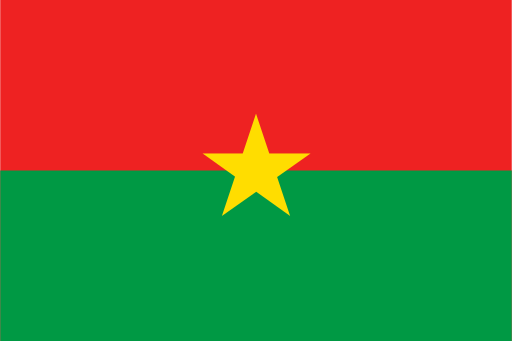
Burkina Faso
Capital
Ouagadougou
Region
Africa
Population
24,070,553
Area (km²)
272,967
Burkina Faso, a landlocked West African nation with a population of around 24 million, spans 272,967 km² and is centered around its bustling capital, Ouagadougou. Known for its gold mining and cotton exports, the country grapples with economic hurdles (GDP data unavailable) amid political instability and jihadist threats. Despite challenges, it boasts a rich cultural tapestry influenced by diverse ethnic groups like the Mossi.
Key Insights
Despite having a large and rapidly growing population (24 million), Burkina Faso remains predominantly rural, with less than 28% of its population living in urban areas. This low urbanization rate (27.787%) contrasts sharply with many developing nations and suggests that the majority of the population lacks access to concentrated infrastructure and services typically found in cities.
Despite being a low-income country facing high resource demands, Burkina Faso maintains a relatively high percentage of forest area, covering 22.173% of its land. This suggests potential success in conservation efforts or a slower rate of deforestation compared to some regional peers, which is noteworthy given the pressure on land resources.
A major infrastructural challenge is the extremely low rate of access to electricity, standing at only 21.70%. This lack of reliable power severely constrains industrial development, limits educational opportunities, and hinders the operation of modern health facilities across the majority of the country.
While Burkina Faso achieved a modest GDP growth of 3.00% in 2023, this growth is barely keeping pace with a low inflation rate of 0.743%. However, given the extremely low GDP per capita ($873.48), this growth is insufficient to significantly lift the population out of poverty, especially with an unemployment rate of 5.348%.
GDP (Current US$)
$20.11B
Year: 2023
GDP Per Capita
$873.48
GDP Growth (%)
3%
Inflation (%)
0.74%
Unemployment (%)
5.35%
Debt to GDP (%)
61.93%
Source: World Bank • Last updated: 12/24/2025
Historical Trends & Data Visualizations
- GDP Growth (%)
- Population
- Life Expectancy (years)
- Renewable Energy (%)
- GDP Per Capita ($)
Share This Country
News
Real Estate
Events
Government
Travel & Tourism
External References & Resources
Wikipedia
Comprehensive encyclopedia article
Grokipedia
AI-powered encyclopedia search
Google Search
Latest news and information
Google News
Latest news coverage for Burkina Faso
CIA World Factbook
Official intelligence data
BBC News
Trusted news and analysis
UN Data
Official United Nations statistics
World Bank Data
Economic and development indicators