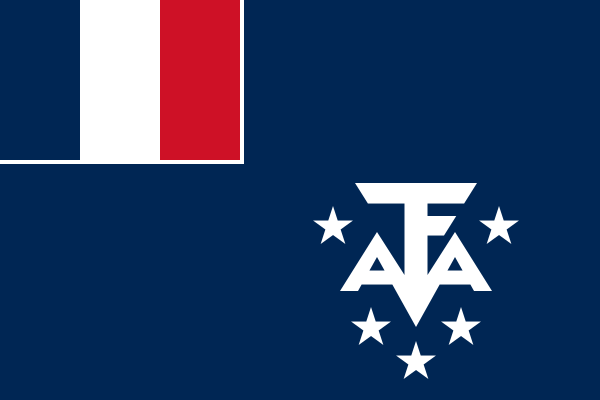
French Southern and Antarctic Lands
Territory of the French Southern and Antarctic Lands
Capital
Port-aux-Français
Region
Antarctic
Population
400
Area (km²)
7,747
The French Southern and Antarctic Lands (TAAF) is a remote overseas territory of France, comprising scattered islands in the southern Indian Ocean and a vast Antarctic claim, with a total area of 7,747 km² and no permanent population—only about 400 rotating scientists and staff. Its "capital" is the research base at Port-aux-Français on the Kerguelen Islands, serving as an administrative hub for scientific expeditions focused on marine biology, climate research, and wildlife conservation. With no GDP data available due to its uninhabited, non-commercial nature, TAAF stands as a pristine wilderness, home to penguins, seals, and unique ecosystems, but accessible only by ship for extreme adventurers.
Key Insights
Its classification in the Antarctic region confirms that the primary challenges and operational focus are environmental, including extreme cold, resource logistics, and biodiversity preservation. Unlike most territories, human activity is subordinate to environmental constraints and scientific mandates.
The vast area (7,747 sq km) supporting only 400 people suggests that the territory's value is not derived from economic output or human habitation, but rather from strategic location, exclusive economic zones (not explicitly listed but implied), and scientific research opportunities.
The designated 'capital,' Port-aux-Français, is not a typical administrative center but rather a permanent scientific research station. This highlights that the territory's governance structure is purely functional, prioritizing scientific and logistical support over traditional civilian administration.
The population of 400 is almost entirely composed of rotating scientific personnel, military staff, and logistical support teams. This means the entire population is transient, lacking permanent residents or an indigenous population, which is a unique demographic characteristic globally.
No economic data available
Share This Country
External References & Resources
Wikipedia
Comprehensive encyclopedia article
Grokipedia
AI-powered encyclopedia search
Google Search
Latest news and information
Google News
Latest news coverage for French Southern and Antarctic Lands
CIA World Factbook
Official intelligence data
BBC News
Trusted news and analysis
UN Data
Official United Nations statistics
World Bank Data
Economic and development indicators